

Benin | Coral Beadwork
How red beads from the Mediterranean became political appointments you couldn't decline

Where we’ve been this month:
We started with brass plaques that documented court ceremonies on palace walls. Then we examined commemorative heads that sat on ancestral altars, facilitating communication between living and dead kings. Last week, we studied the Queen Mother Idia mask, carved from ivory to honor a warrior woman who helped her son win a civil war.
Throughout all these articles, you’ve seen one detail appear again and again: red coral beads. On the bronze heads, covering the neck and chin. On the plaques, showing court officials wearing elaborate necklaces. In Queen Idia’s story, as part of the special privileges that made her Iyoba.
We’ve mentioned coral repeatedly without fully explaining it. That changes today.
This week, we’re unpacking why those red beads mattered so much. Why they traveled thousands of miles from the Mediterranean. Why only the Oba could control who wore them. Why receiving coral beads from the palace could make you a chief, and losing the right to wear them could destroy your political career.
Coral wasn’t jewelry. It was the most restricted material in the entire kingdom. More controlled than brass. More tightly regulated than ivory. The ultimate visible marker of divine royal authority.
Let’s talk about how Mediterranean coral became West Africa’s most powerful status symbol.
The Object Before You
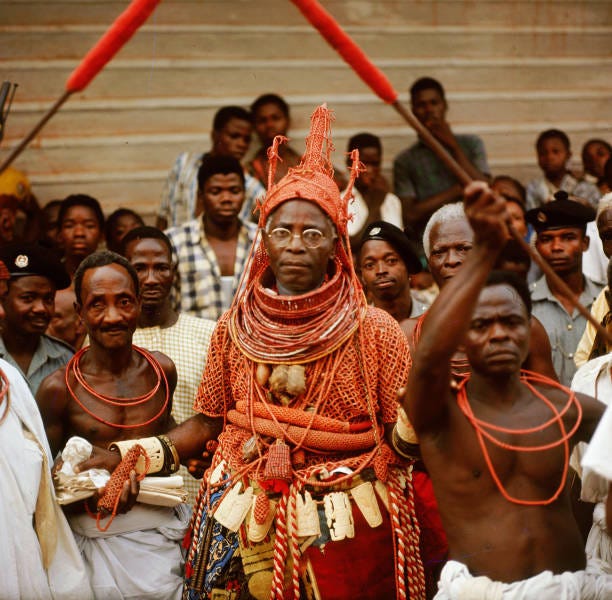
Stand before the Oba of Benin during a major ceremony and you can barely see his face.
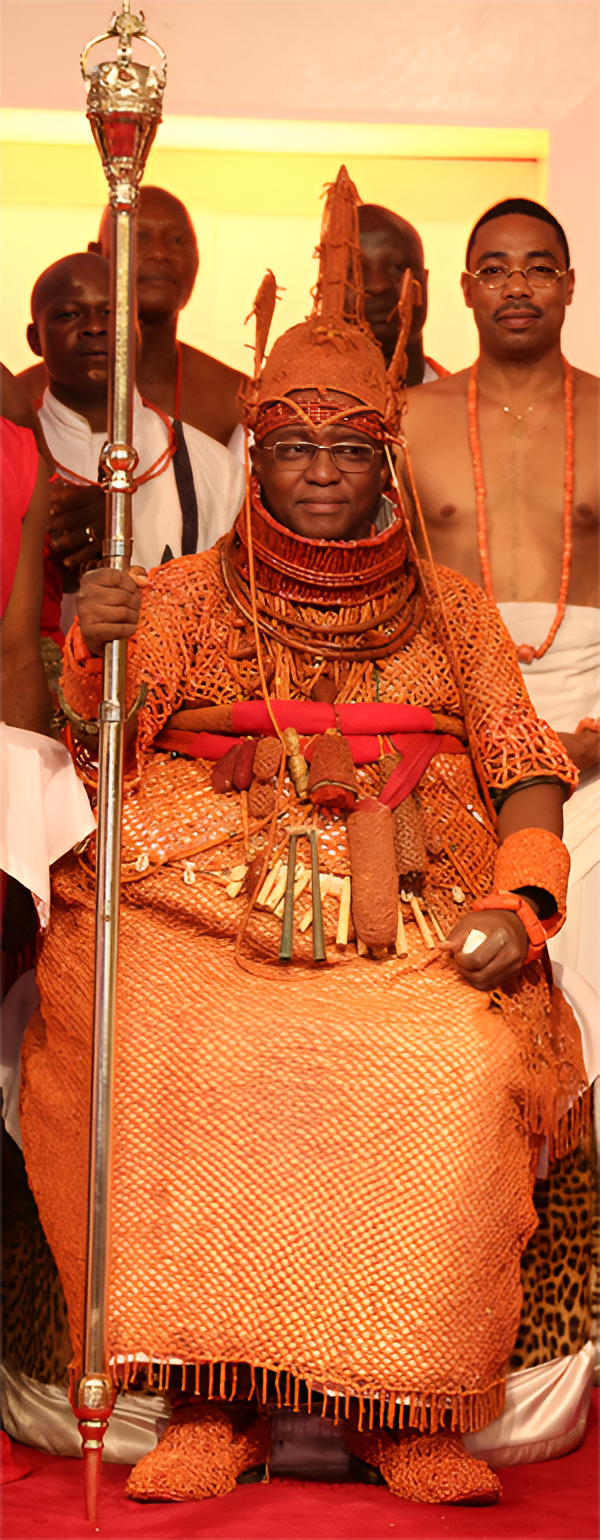
From his shoulders to his lower lip, his entire neck and chin disappear beneath stacked rows of red coral beads. Hundreds of them, perhaps thousands, arranged in perfect horizontal rings that completely cover his throat. The collar is so massive it looks like a second body, built entirely from tiny cylindrical beads that gleam deep crimson in the light.
Above, his crown is woven from more coral beads in intricate lattice patterns. On his chest hang multiple strands of coral necklaces, layer upon layer, covering him from collarbone to waist. His wrists are wrapped in coral bangles. Even his shoes are covered in coral beadwork.
The sheer weight is crushing. Forty, fifty, maybe sixty pounds of coral beads covering his body. Servants stand nearby, ready to periodically remove his crown so they can fan his head and give him relief from the burden.
This is power made visible. This is divine authority you can see and touch. This is the Oba demonstrating that he alone can bear the weight of kingship.
And every single one of those red beads traveled thousands of miles across the Mediterranean Sea to reach his body.
The Physical Portrait: Coral as Sacred Material
What Coral Actually Is
The coral beads that covered Benin royalty weren’t made from stone or clay. They were organic material from the ocean, the skeletal remains of tiny marine animals that formed coral reefs.
There were two main types used in Benin:
Ivie: The most valuable type, a polished red or pink coral that could be buffed to bring out its beautiful color. This was the coral reserved exclusively for the Oba and the highest chiefs. When people say “coral beads” in Benin context, they usually mean ivie.
Ekan: A greyish coral that resembled stone. Less valuable than ivie, but still important and still controlled by the Oba.
Both types originated far from West Africa. The red coral came primarily from the Mediterranean Sea, particularly off the coasts of Italy and North Africa. Some coral also came from the Sea of Japan. These weren’t local materials. Every bead represented long-distance trade networks spanning continents.
How Coral Reached Benin
We’ve discussed how Portuguese traders brought brass manillas starting in the late 1400s. They also brought coral beads, which quickly became one of the most valuable trade goods.
The Portuguese obtained Mediterranean coral and brought it down the West African coast. They traded it to Benin in exchange for pepper, ivory, palm oil, and other goods. The coral trade was so profitable that specific Portuguese merchants specialized in it.
But according to Edo oral tradition, coral has a different origin story. The myths say that Oba Ewuare the Great (who ruled from 1440 to 1473) ventured into the ocean and went to a place called Ughoton. There, he stole red coral beads from Olokun, the god of the sea and source of all wealth and fertility.
This mythological origin was crucial. It meant coral didn’t just come from foreign trade. It came from the gods. It belonged to Olokun, and the Oba had taken it through supernatural daring. This divine origin gave coral beads spiritual significance beyond their material value.


The Omoada: Coral Bead Makers and Weavers
Like the bronze casters and ivory carvers we’ve discussed in previous weeks, coral beadwork had its own specialized guild: the Omoada, the coral bead makers and weavers.
The Omoada were responsible for taking the raw coral beads that arrived through trade and transforming them into wearable regalia. They sorted beads by size, color, and quality. They strung them into specific patterns and shapes: crowns, necklaces, bangles, elaborate chest pieces, and the massive collars that covered the Oba’s neck. Certain designs could only be used by certain ranks.
The Omoada had to know not just how to create beautiful objects but who was allowed to wear what. They were guardians of a visual code that communicated the entire social hierarchy.
The guild worked exclusively for the royal court, like all Benin craft guilds. They couldn’t make coral regalia for anyone without the Oba’s permission. This gave the Oba complete control over who could display this ultimate status symbol.
The Heart of the Matter: The Coral Monopoly
Who Could Wear Coral
In previous weeks, we’ve discussed brass as royal material and ivory as connected to spiritual purity. Coral operated differently. It was the most restricted material of all.
The Oba could wear unlimited coral. Full collar covering neck and chin. Elaborate crown. Multiple chest-covering necklaces. Bangles on both wrists. Coral-covered shoes. The more coral, the more authority displayed.
The Iyoba (Queen Mother) had the special privilege of wearing coral beads including a coral crown, something normally reserved only for the Oba. This exception showed her unique status. As we discussed last week with Queen Idia, the Iyoba was the only woman who could wear royal coral.
The Heir Apparent could wear coral, marking him as the future Oba.
The Ezomo (supreme war chief) was granted the privilege of wearing a coral crown, a special honor extended during specific periods of Benin history.
Certain High Chiefs could wear coral beads on their necks and wrists, but the amount, pattern, and style were strictly regulated. They couldn’t wear collars that covered the chin like the Oba’s. They couldn’t wear coral crowns.
Everyone Else couldn’t wear coral at all. Not minor chiefs. Not wealthy traders. Not successful craftsmen. No amount of money could buy you the right to wear coral if the Oba hadn’t granted it.
This absolute control made coral more than jewelry. It was a visible marker of exact rank that everyone could read instantly. If you saw someone wearing a coral collar, you knew they were extremely close to royal power. If you saw someone in a coral crown, you knew they were either the Oba, the Iyoba, or someone granted an extraordinary privilege.


How Coral Beads Made and Unmade Chiefs
The Oba didn’t just control who wore coral. He used coral to make political appointments and exercise power.
Making a Chief: When the Oba wanted to honor someone and make them a chief, he sent coral beads to them. This wasn’t a request or an offer. When coral beads arrived from the palace, you were being made a chief. Refusing was considered an “unpardonable sin” according to Edo tradition. You couldn’t say no to coral from the Oba.
The specific beads you received indicated your exact rank. More beads meant higher status. Certain patterns meant specific positions. The coral itself was the official appointment, not a document or ceremony (though ceremonies followed).
Breaking a Chief: If a chief or his family brought shame to the monarchy or disagreed with the Oba in serious ways, they could be forbidden from wearing coral beads. This was public humiliation. Everyone could see that you’d lost royal favor. Your status evaporated visibly. You went from displaying authority to displaying disgrace.
Taking away someone’s coral rights was political punishment that required no explanation. The absence of beads communicated everything.
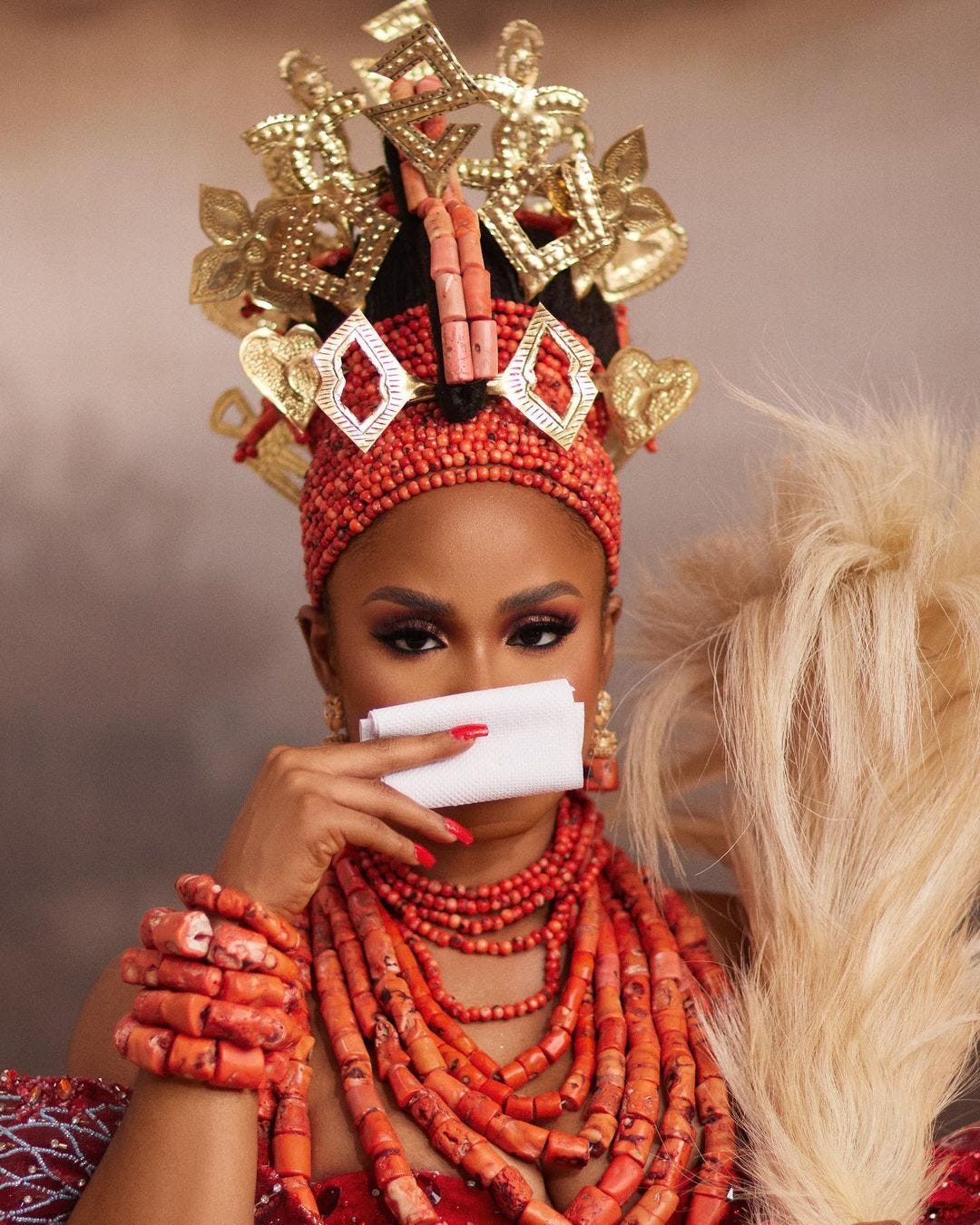
Marriage and Status: When the Oba sent coral beads to a single woman, it symbolized a marriage proposal that she was bound to accept. During the wedding ceremony, Edo brides wore Okuju, a beaded crown that either sewed coral into their hair or was worn like a wig. This tradition continues today, with Edo brides wearing elaborate coral bead jewelry as part of their wedding attire, though now it’s decorative rather than indicating royal marriage.
The Spiritual Power of Coral
We’ve mentioned Olokun, the god of the great waters, in previous weeks. Now we can go deeper into why coral connected to Olokun specifically and why that mattered.
Olokun as Source: In Edo cosmology, Olokun is the deity who controls wealth, fertility, and prosperity. He lives in a palace beneath the Ethiope River, which the Edo believe is the source of all the world’s waters. From this underwater kingdom, Olokun sends blessings to faithful devotees.
Coral as Olokun’s Property: The myth of Oba Ewuare stealing coral from Olokun at Ughoton meant that coral beads belonged to the god of wealth. When you wore coral, you were wearing Olokun’s property. This connected you directly to the source of prosperity and fertility.
The Oba as Olokun’s Representative: According to Edo mythology, the Oba is descended from Olokun. He rules the land as Olokun’s representative, just as Olokun represents the supreme god Osanobua. By wearing coral (Olokun’s material), the Oba was displaying his divine ancestry and his connection to the god who controlled all wealth.
Protective Incantation: Before major ceremonies, the Oba recited a famous incantation over his coral regalia: “Oh corals, when I adorn myself with you, endow me with wisdom and keep me apart from evil spirits and spells of the wicked and witch-doctors.”
This wasn’t poetic language. The Edo believed coral actually protected against witchcraft and negative spiritual forces. The beads enhanced the wearer’s spiritual strength and deflected harmful magic. For the Oba, whose spiritual health affected the entire kingdom’s wellbeing, this protection was essential.
Weight as Spiritual Burden: The physical heaviness of coral regalia held spiritual significance. The Oba had to bear enormous weight, both literally and metaphorically. The coral demonstrated that he could carry the burden of kingship. Lesser people couldn’t support that weight physically or spiritually. The Oba’s ability to wear crushing amounts of coral proved his fitness to rule.
The Human Context: Coral in Daily Life and Ceremony
Annual Coral Festivals
Coral wasn’t just worn occasionally. It was central to the most important ceremonies in Benin’s calendar.
During the annual Igue festival (which we’ve mentioned in previous weeks as the ceremony that renewed the Oba’s powers), coral regalia played a crucial role. The Oba appeared in full coral dress, demonstrating his authority to the entire kingdom. Chiefs came to the palace wearing their coral beads, displaying their ranks and receiving the Oba’s blessings for the coming year.
Periodic coral festivals were held yearly specifically to honor the coral itself. These ceremonies acknowledged the beads’ divine origin and renewed their protective powers. The Oba would ritually consecrate his coral regalia, strengthening its spiritual force.
Coral in the Bronze Artwork We’ve Studied
Now that we understand coral’s significance, we can look back at the objects from previous weeks with new understanding.
The Bronze Plaques (Week 0): Remember those plaques showing court officials and the Oba? Look closely at what they’re wearing. Almost every figure has coral beads depicted in the brass. You can see the Oba with his massive collar. You can see chiefs with coral necklaces. You can identify who held what rank by counting the rows of beads carved into the metal.
The Commemorative Heads (Week 1): The elaborate collars on those brass heads? Those represent coral beads. The collars grew taller and more elaborate over centuries, showing how the Oba’s coral regalia became increasingly massive as the kingdom accumulated wealth. The heads document the evolution of coral as status symbol.
The Queen Idia Mask (Week 2): We noted that Queen Idia, as Iyoba, received special privileges. One of the most important was the right to wear coral beads usually reserved for the Oba. This exceptional status is depicted in brass artwork showing the Iyoba with coral regalia.
All the art we’ve studied has been documenting coral. We just didn’t fully understand what we were seeing until now.


The Economics of Coral
Coral’s value came partly from its scarcity. It had to be imported from thousands of miles away. Portuguese merchants charged high prices. The Oba had to trade valuable goods (pepper, ivory, palm oil) to obtain it.
But once coral entered the kingdom, the Oba controlled it absolutely. No private individual could import coral. No trader could buy it independently. All coral belonged to the palace.
This created a closed economic system. The Oba had a monopoly on both the supply (through trade control) and the distribution (through his power to grant or revoke coral rights). This gave him enormous economic leverage over chiefs and officials who depended on coral to display their status.
Chiefs who wanted to maintain or increase their coral allotment had to please the Oba. They had to demonstrate loyalty, provide good service, and avoid offending royal authority. Coral became a tool for managing the entire political class.
Red as Royal Color
The deep red color of the finest coral beads (ivie) became strongly associated with royalty. Red cloth, red parrots’ feathers, red copper, red camwood dye, all red materials took on royal associations because of coral’s importance.
In traditional Edo dress, red elements still signal formality, status, and connection to cultural heritage. While coral beads are no longer restricted to royalty, they remain the most prestigious element of traditional attire for weddings, festivals, and important ceremonies.
The Journey and The Now: Coral After 1897
What the British Took
When British forces invaded Benin City in 1897, they looted the Oba’s coral regalia along with brass plaques, commemorative heads, and ivory carvings.
The coral regalia of Oba Ovonramwen (who was exiled after the invasion) was taken with him to Calabar, where he died in 1914. Unlike most looted objects that scattered across European museums, the coral regalia was eventually brought back to Benin.
In 1938, Ovonramwen’s coral regalia was returned to Benin City. This was a rare early example of restitution, happening decades before the broader restitution movement gained momentum. The coral’s return allowed the restored monarchy to resume certain ceremonies with authentic royal regalia.
Coral in Modern Benin
Today, coral beadwork remains central to Edo cultural identity, though its meaning has shifted.
The Current Oba (Oba Ewuare II, crowned in 2016) still wears coral regalia during major festivals and ceremonies. He maintains the tradition of appearing in full coral dress during Igue festival. The coral still signals divine authority and connection to Olokun.
Chiefs and Officials still receive coral beads as markers of rank. The system of using coral to indicate status continues, though modified for modern political realities.
Edo Weddings: Coral beadwork has become the signature element of traditional Edo weddings. Brides wear elaborate coral crowns, necklaces, and bangles. Grooms wear coral accessories. What was once restricted to royalty has become popular traditional dress, though everyone understands its royal origins.
Commercial Production: Coral beads are now produced commercially and sold in markets. They’re no longer controlled exclusively by the Oba. This democratization means anyone can wear coral, but it also means the beads no longer function as the strict status marker they once did.
Cultural Preservation: Many Edo people see coral beadwork as a link to their heritage. Wearing coral at traditional ceremonies connects modern Edo to centuries of history. It keeps alive the memory of when these red beads signaled divine kingship.
Why This Matters: Material as Power
What Coral Reveals About Benin’s System
We’ve now studied brass (Week 0 and 1), ivory (Week 2), and coral. Together, these materials reveal how Benin’s political system actually worked.
The Oba didn’t control power through military force alone. He controlled it through monopolies on valuable materials. By controlling brass, ivory, and coral, he controlled who could display status, who could commission art, who could wear symbols of authority.
Visual hierarchy was political hierarchy. You didn’t need documents or titles. You could read someone’s rank by looking at what they wore. The amount and type of coral beads someone displayed told you exactly where they stood in relation to royal power.
Foreign trade strengthened, not weakened, royal authority. Portuguese traders brought coral from the Mediterranean, but this didn’t give them power in Benin. It gave the Oba more power, because he controlled the coral once it arrived. Foreign materials became tools of indigenous political control.
Spiritual beliefs supported political systems. The myth of Oba Ewuare stealing coral from Olokun wasn’t just a story. It was political theology. It explained why the Oba controlled coral (he took it from the gods) and why wearing coral meant connecting to divine power.
The Weight of Authority
The physical weight of coral regalia is worth considering seriously.
Wearing forty to sixty pounds of beads is genuinely difficult. It’s hot. It’s constraining. It causes physical strain. Servants had to help the Oba manage the weight during long ceremonies.
But that was exactly the point. Kingship was meant to be a burden. The Oba bore responsibilities that affected millions of people. He mediated between the visible and invisible worlds. He maintained cosmic balance. His decisions determined whether the kingdom prospered or suffered.
The coral made this metaphorical burden physical. It said: leadership is heavy. Authority is crushing. If you can’t bear the weight of coral, you can’t bear the weight of kingship.
Lesser officials wore less coral because they bore less responsibility. Common people wore no coral because they bore no political burden at all.
The system was brutally honest about what power meant.


Reflection: Red Beads That Ruled a Kingdom
Stand before someone wearing coral beads today at an Edo wedding, and you’re seeing an echo of a system that once organized an entire kingdom.
Those red beads traveled from Mediterranean coral reefs through Portuguese trade networks to West African shores. They were transformed by specialized craftsmen into elaborate regalia. They were distributed by royal decree to mark political appointments. They were taken away as punishment. They were blessed in annual ceremonies. They were believed to protect against witchcraft and connect wearers to divine power.
They were, for centuries, the most restricted luxury good in one of Africa’s most powerful kingdoms. More restricted than brass. More restricted than ivory. More tightly controlled than gold.
Why? Because coral did something other materials couldn’t. It was visible from a distance. It could be worn on the body during public appearances. It came in quantifiable amounts (you could count rows of beads). It was durable enough to last generations but rare enough to remain precious.
Coral was the perfect material for turning political hierarchy into something you could see and touch. It transformed abstract concepts like “royal authority” and “chiefly status” into physical objects that everyone could read.
And it came from the sea, from Olokun, from the god who controlled wealth and fertility. Wearing it meant more than displaying status. It meant carrying divine power on your body.
The British invasion broke the Oba’s coral monopoly. The economic changes of the 20th century made coral more widely available. Modern Edo society has democratized access to these once-royal beads.
But every Edo bride who wears coral at her wedding, every chief who receives coral beads from the current Oba, every person who puts on coral jewelry for a traditional ceremony is participating in a tradition that stretches back more than 500 years.
The red beads still matter. They just carry different meanings now. Political hierarchy became cultural heritage. Divine authority became traditional pride. Royal monopoly became shared identity.
The coral traveled thousands of miles to reach Benin. The tradition it created has traveled across five centuries to reach us. Both journeys are remarkable. Both are worth remembering.
Discussion Question: Coral beads were once so restricted that refusing them from the Oba was "unpardonable sin," but today anyone can buy and wear them. What do you think was gained and lost when coral went from royal monopoly to cultural heritage available to all?
Further Reading and Resources
See the Objects:
British Museum Collection Online - Multiple bronze plaques and heads showing detailed coral regalia
Metropolitan Museum of Art - Excellent examples of coral depictions in brass artwork
Digital Benin (digitalbenin.org) - Search for objects showing coral beadwork across different art forms
Accessible Articles:
“The Cultural Significance of Coral Beads To The Benin People” (Guardian Nigeria) - Overview of coral’s traditional and modern meanings
“Significance of coral beads” (The Nation Nigeria) - Contemporary perspective on coral in Edo culture
“Beads in Benin culture: royalty, beauty and more” (Nigerian Observer) - Broader look at beadwork traditions
For Deeper Understanding:
“Art of the Kingdom of Benin” (Wikipedia) - Includes information about materials and their significance
Museum sources cited in previous weeks - Look back at plaque and head depictions with new understanding of what the coral details mean
Culture of the Month: Benin City
You’re currently reading part of our February deep-dive into Benin cultural design intelligence. Explore the full series:
→ Week 0 — Benin | Introduction: The City That Built an Empire
→ Week 0 — Design Spotlight: Benin | Bronze Plaques as Empire Archives
→ Week 1 — Design Spotlight: Benin | The Bronze Heads: When Ancestors Live in Metal
→ Week 2 — Design Spotlight: Benin | The Queen Mother Mask
→ Week 3 — Design Spotlight: Benin | Coral Beadwork
This series explores how Benin artists used material, symbolism, and structure to preserve memory, power, and identity, long before modern design systems existed.