

The Tuareg | Ehan (Ehel) - Architecture as Women's Ownership
How portable architecture became legal contract, economic security, and a map of the invisible world

Last week, we looked at the tagelmust, the indigo veil that marks Tuareg men and stains their identity into their skin. This week, we’re studying something that belongs exclusively to women: the tent.
Fifteen women sit in a circle in the sand. They’ve been sewing for two days, stitching narrow strips of goat hair cloth edge to edge until individual pieces become something large enough to shelter a family. The bride is nearby. This is her tent, the one her mother and aunts wove strips for over months, the one that will bear her name when it’s finished, the one her husband will enter but never own.
By morning, the tent will stand for the first time, erected as part of the wedding ceremony itself. In Tamasheq, the Tuareg language, the phrase for getting married translates literally as “Making a tent.” Not starting a family. Not joining households. Making a tent. The marriage and the structure are the same act described in the same words, and that tells you everything you need to know before we’ve even begun.
The object before you
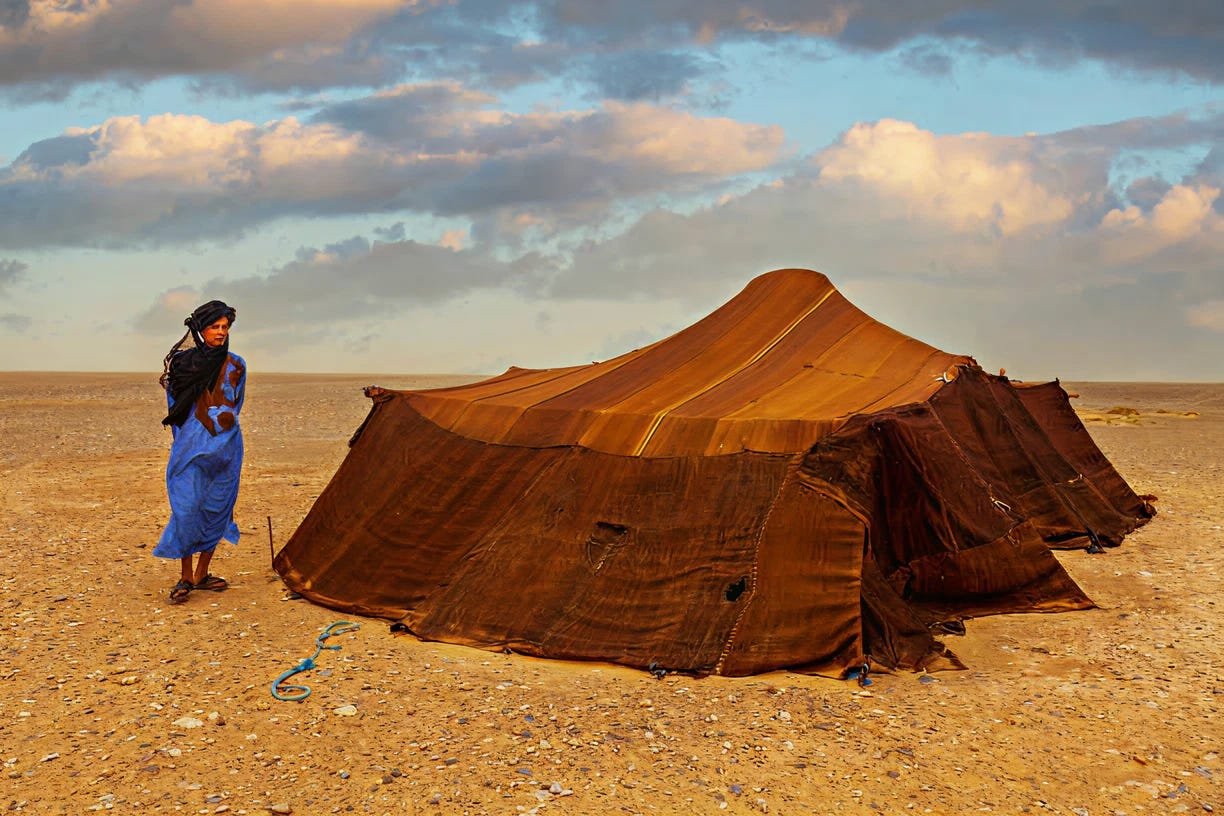
Step inside a Tuareg tent and the first thing you notice is the smell. Goat hair and smoke and leather and earth, warm and animal and alive. The light filters through the velum panels overhead, not bright and not dark, somewhere in between, a brown-gold glow that softens everything inside.
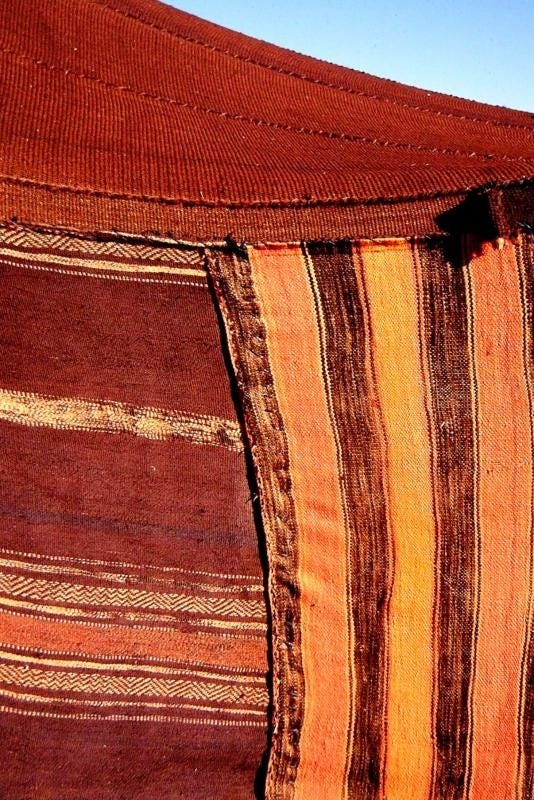
The walls and roof are made from velum, panels of goat hair cloth woven tightly enough to block wind and provide shade but loosely enough to let air circulate. Run your hand across the surface and you feel the coarseness of goat hair, dense and slightly oily, nothing like cotton or linen. This texture is functional. The fibers swell when they get wet, closing the gaps between them so rain sheds off the surface. In a place where rain is rare but survival-critical when it falls, that swelling is the difference between a dry household and a soaked one.
The velum isn’t one continuous piece. It starts as narrow strips, each maybe thirty to fifty centimeters wide, woven individually by women on ground looms. You can see the seams where the strips were joined, horizontal lines running across the tent’s surface like stitching on a quilt. These lines are evidence. They mark where women sat together, hands moving through the same repetitive motion, sewing a home into existence.
The form of the tent changes depending on where you are. In Algeria, gable tents with peaked roofs. In Mali, pyramid shapes that rise to a central point. In Niger, dome tents that curve smoothly from ground to apex. A traveler who knew what to look for could identify a family’s region of origin just by glancing at the shape of their roof.
The color is the landscape’s own palette. Natural brown-black of goat hair, sometimes with lighter tan or cream strips woven in. Nothing bright, nothing that would stand out against sand and rock and scrub. The tent doesn’t announce itself. It belongs where it stands.
The wooden pole skeletons that gives this soft structure its form. Some are plain, functional, just the right diameter and length to do their job. Others are covered in carved geometric patterns, stylized animals, abstract designs that carry meaning. These carved poles are Inadan work, made by the blacksmith-artisan caste we’ll spend more time with next week.
One pole stands apart from the rest. It’s longer than the others, positioned at the tent’s entrance, and noticeably less decorated. This is the threshold pole, and its job is not primarily structural. It marks the boundary between the human realm inside the tent and the spirit world outside, the place where djinn and Kel Eru move freely. Every time you step past that pole, you cross from one order of reality into another.
The tent can be assembled in a few hours and taken down just as quickly. Poles bundle, velum folds, ropes coil. Everything loads onto pack animals and moves to the next camp. When the family arrives at the next water source, the same components rebuild the same home in the same configuration, and life continues as if the ground beneath them hadn’t changed at all.


How It’s Made and Who Makes It
The Velum: Women’s Weaving
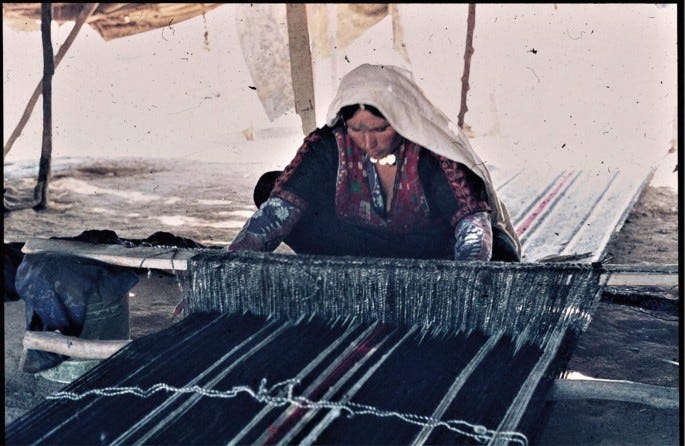
The goat hair cloth begins its life on women’s looms. A woman shears the goats, cleans the hair, cards it to align the fibers, spins it into yarn. She works alone, at her own pace, weaving the strips in the intervals between everything else her day requires. This is not a single dedicated production period. It’s a task threaded through months of daily life, a strip here and a strip there, building gradually toward the quantity needed for a full tent.
Each strip she weaves is hers. She decides when to weave, how many strips to produce, what patterns to include if any. The labor is recognized as women’s work producing women’s property.
When enough strips exist, the communal sewing begins. This is the part that turns raw material into architecture. Fifteen to twenty women gather, each bringing what she can contribute, and they stitch strips together edge to edge until individual pieces become the panels that will form walls and roof. They talk while they sew. They sing. They teach younger women by having them work alongside, hands learning the rhythm of joining fabric while ears absorb conversation and instruction.
A tent born from this kind of labor arrives in the world already laced with community. The women who sewed the panels together have a relationship to this structure and to the woman who will own it. The tent is personal property, but it was collectively made, and that combination of individual ownership and communal creation runs through the entire Tuareg material culture.
The Poles: Inadan Carving
The wooden poles come from Inadan men. They select the wood, usually acacia or other dense hardwoods that resist splitting, and carve each pole to the specifications the tent requires. Length, diameter, surface treatment, decorative elements, all of these are decisions made between the woman commissioning the tent and the craftsman interpreting her needs through his training and aesthetic sense.
The threshold pole, the one that separates domestic from spirit space, gets minimal decoration. Its function is too serious for ornament to compete with. The interior poles that divide gendered spaces and privacy zones are often more elaborate, their carvings carrying protective meanings alongside decorative beauty.
The result is a set of poles tailored to one specific tent, one specific household. Not interchangeable parts from a factory. Objects made for this woman, this marriage, this particular way of organizing space and life.
What the Tent Actually Does
Marriage: Making a Tent
The bride’s family provides the tent. Her mother, aunts, sisters, and female relatives have woven the strips, gathered for the sewing, and now present the completed tent to her as part of her marriage portion. It is hers before her husband ever steps inside it. He enters her property.
During the wedding ceremony, the tent goes up. The poles are fitted together, the velum panels draped and secured, the ropes staked into the ground while the community watches. The marriage is made because the tent is made.
The tent is named after her. When people refer to this household, they use her name, not his. He may contribute livestock, tools, goods that become part of the household economy. But the structure itself, the thing that makes this household a physical reality in space, that belongs to the woman.
Divorce: When the Man Leaves
If the marriage ends, the man packs whatever personal belongings are unambiguously his and walks away. The tent stays standing. The children stay with their mother. The livestock that came through her family remain hers.
He becomes, at least temporarily, homeless. He returns to his mother’s tent, or his sister’s, or he enters a new wife’s tent if he remarries. Think about what this means practically. A woman whose marriage fails is not scrambling for shelter, not dependent on charity, not negotiating for a share of assets that someone else controls. She has her tent. She has her children. She has her livestock. She has her life, materially intact, the morning after her husband walks away.
And for men, the knowledge that divorce means losing your home and your household creates its own kind of accountability. You do not mistreat someone when the consequence is walking into the desert with whatever you can carry on your back.
Death: When the Tent Dies
When the woman who owns the tent dies, the tent comes down. It is to be destroyed.
The poles are distributed to family who can use them. The velum panels are given away piece by piece. And the space where the tent stood is left empty. The ground that held her household holds nothing, a physical silence where a life used to be.
Her daughters don’t inherit the physical structure. They inherit the practice. When they marry, new tents will be woven and sewn for them by communities of women, just as this tent was made for their mother. What continues across generations is not the object itself but the knowledge that a tent belongs to the woman whose name it bears, and that this belonging is the foundation of everything else.
Cosmology: Space as Map
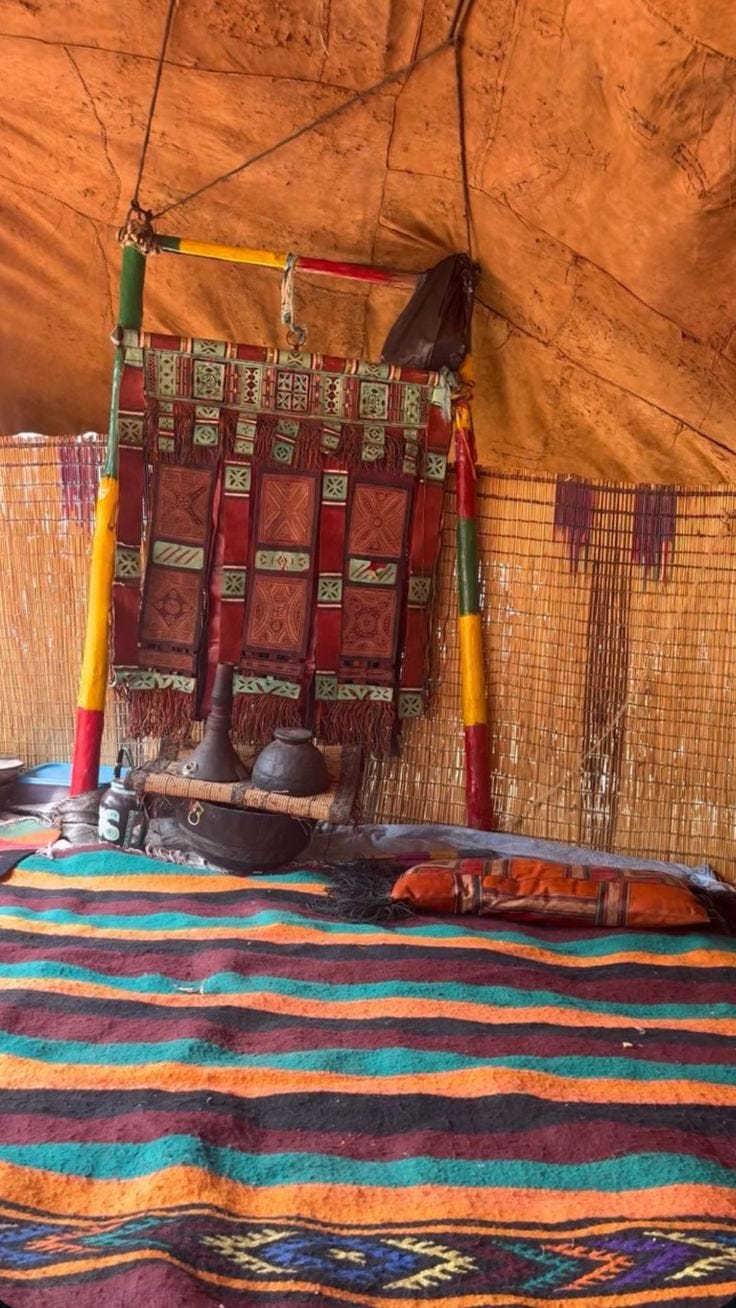
Inside the tent, the space is a map of the world as the Tuareg understand it.
The threshold pole at the entrance separates human domestic space from the spirit world outside, where djinn and Kel Eru roam. Cross that pole and you’re inside human territory. Step beyond it and you’re in theirs.
The area nearest the entrance is public and male. This is where guests are received, where the tent opens itself to the outside world. Move deeper and the space becomes more female, more private, more restricted. The back of the tent holds valuables, private family matters, the most intimate layers of household life.
A male guest entering the tent knows exactly how far he can go. He doesn’t need to be told. The poles and the arrangement of objects tell him. The architecture enforces social boundaries silently, through the spatial facts of how the interior is organized.
At night, men and boys sleep closer to the entrance, women and girls toward the back. The arrangement varies with family size and composition, but the principle stays the same. You sleep where you belong in the social order, and the tent reminds you every night where that is.
Living in Moving Architecture
Assembling and Dismantling
A woman who owns a tent knows how to build it because she’s been building tents since she could walk. She watched her mother direct assembly. She participated in camp setups dozens or hundreds of times before receiving her own tent. By the time she’s standing over her own ehan for the first time as a married woman, telling people where the poles go and how the velum drapes, the knowledge is in her hands as much as in her head.
Getting it right matters. Drape the velum wrong and wind catches it, tears it. Stake the ropes at bad angles and the whole thing sags. Position the poles carelessly and the interior divisions don’t work. This is technical knowledge disguised as routine domestic labor, the kind of expertise that gets overlooked precisely because women do it and because it happens so frequently it looks ordinary.
Taking it down is faster, but just as particular. Velum folded wrong develops permanent creases. Ropes tangled during packing mean chaos at the next camp. Poles bundled loosely fall apart on the journey. Everything has its place in the packing order, and the women who manage this process carry a mental model of the entire system, disassembled and reassembled, in their memory.
The cycle of building and dismantling creates a relationship with the tent that goes far beyond living in it. You construct it, maintain it, repair it, pack it, carry it, and rebuild it over and over across a lifetime. The architecture is never background. It’s an active practice.
Maintenance and Repair
Goat hair cloth under constant use wears down. The velum develops holes. Seams weaken where stress concentrates. Exposure to wind, sun, sand, and the cycle of folding and unfolding takes its toll on organic material that was never meant to last forever.
Women repair their tents continuously. Patching holes, replacing worn strips, reinforcing weakened seams. This labor never reaches a finished state. The tent is always in some stage of needing attention, and keeping it functional is part of the ongoing work of owning it.
Over years, sections of velum get replaced as they wear out. New strips woven, new panels sewn, old material removed. Eventually, an entire tent might be renewed piece by piece until none of the original material remains. The tent persists as the same tent, this woman’s tent, even as its physical substance changes completely beneath her hands.
What Persists, What Changed
Sedentarization: When Tents Stop Moving
French colonial policies in the late 1800s and early 1900s restricted Tuareg movement. Borders appeared across migration routes that had sustained communities for generations. Post-independence governments continued the pressure. Fixed addresses, identity documents, administrative systems built for people who stay in one place. Nomadic life became, slowly and deliberately, impossible for many families.
For many Tuareg, this meant permanent structures for the first time. Mud-brick houses with walls that don’t fold and rooms that don’t travel.
Something interesting happened. The tent moved into the courtyard. A family might live in a mud-brick house built by or for the husband, and the wife’s tent would stand in the outdoor space behind or beside it. The tent remained hers. It still bore her name. It still functioned as women’s space.
But it no longer moved. And portability was one of its core powers. When a tent can travel, women’s economic security travels with them. When a tent sits in a fixed courtyard attached to someone else’s permanent building, the ownership claim persists but the independence it enabled is different. You own the tent. You live in the house. The relationship between those two facts is more complicated than either one alone.
This is what sedentarization did to women’s material circumstances without anyone having to announce it directly. The tent as women’s property survived. The conditions that made it powerful shifted underneath.
What Continues
In rural areas where nomadic pastoralism remains viable, the full system still works. Women own tents. Families move seasonally. Marriage still means making a tent. Divorce still means the man leaves. This is life being lived, today, in the Sahara and the Sahel.
In cities and among families sedentary for generations, the tent’s role has narrowed to ceremony and identity. It goes up for weddings, for important cultural events, and comes down afterward. It still means something. It still says “we are Tuareg.” But it no longer organizes daily life the way it did when movement was survival.
Climate change is compressing what remains. Desertification, unpredictable rainfall, water sources drying up. These aren’t political decisions. They’re ecological facts, and they’re making nomadic life harder to sustain even where governments would allow it. The desert that shaped Tuareg design intelligence is becoming less habitable, and the material culture it produced is adapting or retreating alongside the people who carry it.
What Women Built Into Walls
The Tuareg tent is proof that you don’t need written law or formal courts to structure women’s economic autonomy. You can build it into the walls. You can weave it into goat hair cloth and carve it into acacia poles and make it so fundamental to how households work that undoing it would mean unmaking the entire system.
And that is exactly what sedentarization and climate change are doing. Slowly, from the outside, through forces that have nothing to do with whether the principles are good or right or worth preserving. The system worked because movement worked. When movement stops, the system changes.
What remains is the knowledge. That a home can belong to a woman. That “making a tent” can mean “making a marriage.” That when a household ends, the space it occupied can be left empty out of respect for the person who held it together. That architecture can carry law, economics, gender relations, spiritual practice, and political order all at once, in something you can fold up and carry with you.
Thank you for taking the time to read this article. I hope it sparked reflection and offered something new to carry into your own practice, it certainly did for me. Save it, share it, and most importantly, support the artists, weavers, architects, and communities who keep these traditions alive.
This is a living document. If you notice a missing link, detail, or thread worth adding, let me know so we can keep building this archive together.
Are you a designer, researcher, or keeper of cultural knowledge? I’d love to hear your perspective in the comments or connect directly via DM.
With love and reverence,
Helen