

The Tuareg | Introduction: Design Intelligence from the Sahara
When the desert teaches you to carry your wealth on your body and write your home in the sand

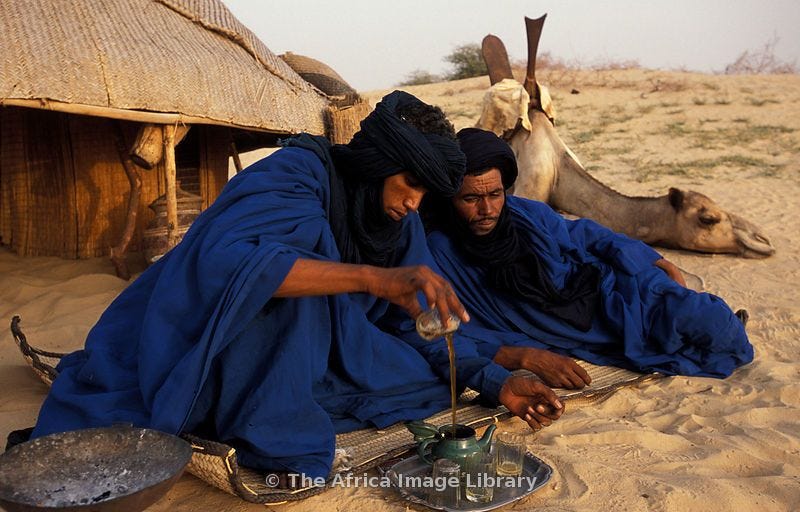
For over a thousand years, the Tuareg have moved across one of the harshest environments on Earth, navigating territories that now span Algeria, Libya, Niger, Mali, and Burkina Faso. They are Berber pastoralists who turned scarcity into a design challenge and solved it with systems so sophisticated that every object in their material culture does multiple jobs at once.
The Tuareg call themselves Kel Tamasheq (speakers of Tamasheq) or Kel Tagelmust (People of the Veil). They organized into confederations led by traditional chiefs called Amenokal, each managing vast territories through councils of elders. Their society has always been stratified: nobles, vassals, religious scholars, artisans, and formerly enslaved people, each group with specific roles and knowledge systems. The artisan caste, the Inadan, hold the knowledge of metalworking, woodcarving, and leatherwork. Women weave tent panels and own the architecture they create. Knowledge moves through specific channels, mother to daughter, father to son, master to apprentice.
Two forces shaped everything the Tuareg made: nomadism and the spirit world.
Nomadism meant objects had to be portable, durable, repairable, and multi-functional. You could not accumulate possessions that could not move with you (similar to the Mongols). Women wore their wealth as jewelry because jewelry travels. Tents could be assembled and disassembled in hours because permanence was a liability. Every object had to serve material, social, and spiritual purposes simultaneously.
The spirit world was not metaphor. Djinn could possess you. The spirits of the dead (Kel Eru) roamed the desert looking for travelers to inhabit. Evil eyes and evil mouths could harm you if your face was exposed. The blacksmith's forge connected to non-Islamic fire spirits, which is why artisans were both essential and socially separated. Objects were not just functional. They were protective technologies.
French colonization in the late 1800s shattered the political autonomy the Tuareg had maintained for centuries. Colonial borders carved their territory into nation-states. Restrictions on nomadism disrupted ancient migration patterns. Multiple rebellions followed: 1916-1917, 1963, 1990-1995, 2007, and 2012. Each one was the Tuareg fighting for autonomy in lands they had moved through for a millennium before nations existed.
Today, severe droughts and desertification are making nomadic life nearly impossible. Many Tuareg have been forced into cities. Political conflicts in Mali, Niger, and Burkina Faso continue.
But the design intelligence persists. Tuareg musicians like Tinariwen, Bombino, and Mdou Moctar tour globally, carrying the culture forward through sound. Artisan cooperatives in refugee communities produce silver jewelry and leather goods. Women still teach their daughters the ancient Tifinagh script, keeping a 2,000-year-old writing system alive through matrilineal transmission.
This month, we are studying four Tuareg design systems. Each one reveals a different dimension of how people think when the environment is hostile, mobility is survival, and the invisible world shapes the visible one.
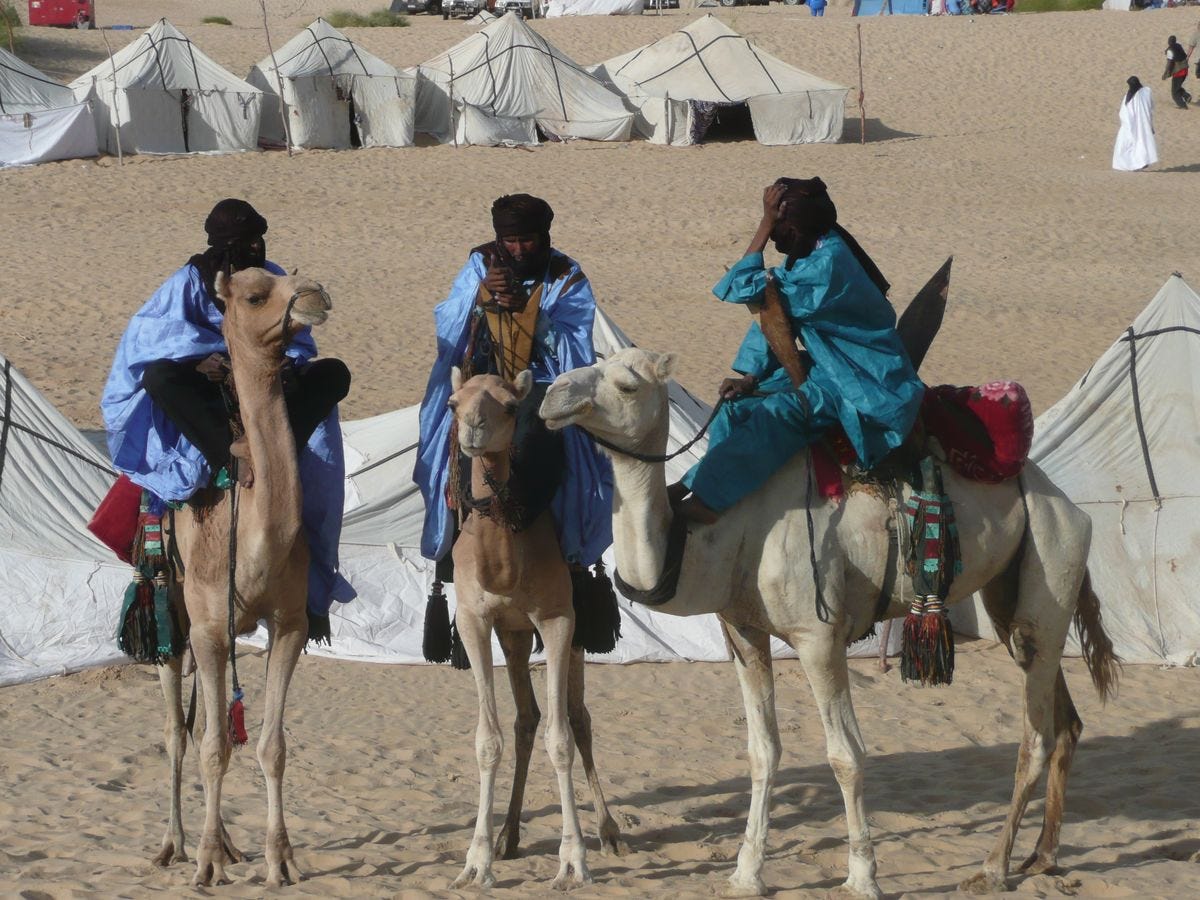
What’s Coming this month
Week 1: The Tagelmust The tagelmust is a coming of age cloth, a spiritual armor against djinn and the spirits of the dead who roam the desert. The indigo dye is pounded into the cloth rather than soaked because water is too scarce for dye baths. The dye leaches into the skin permanently, staining the wearer blue. This is how the Tuareg became known as the Blue People of the Sahara.
Week 2: Ehan (Ehel) The Tent That Belongs to Women When a Tuareg couple marries, a tent is constructed for the first time. Fifteen to twenty women sew the goat hair panels together. The tent is given to the bride and is named after her. It belongs to her.
If the marriage ends, the man has to leave. The tent, the children, and the livestock stay with the woman and the husband becomes homeless. When a woman dies, her tent is demolished. The matting is given away and the space it occupied is left empty.
Week 3: Silver Jewelry and the Inadan’s Fire Spirits The Inadan are blacksmiths. They make silver jewelry, carved tent poles, weapons, saddles, and tools. They are considered socially inferior and their craft is understood as spiritually impure.
And yet, they control the fire spirits of the forge.
The jewelry they create carries the cosmos: triangles for women, eyes for protection, animal tracks and celestial bodies compressed into geometric patterns. Women wear this jewelry as portable wealth. The Agadez Cross is the most recognized form, though many of its twenty-one variations were invented during colonial tourism rather than ancient tradition.
Week 4: Tifinagh Script Tifinagh is not a Tuareg invention. It is an ancient Libyco-Berber script over 2,000 years old. The Tuareg did not create it. But Tuareg women kept it alive. While men learned Arabic to read the Quran, women transmitted Tifinagh from mother to daughter. They used it for love letters their husbands could not read, for poetry, for secret messages carved into rocks, for inscriptions on instruments.


What Makes This Different
These four systems show you how constraint can become creativity when survival depends on it.
The tagelmust reveals that a single object can be an initiation ritual, a spiritual protection, a social communication, and a political symbol all at once. The tent shows that women’s property rights can be built into architecture and that space itself can organize cosmology. The jewelry demonstrates that artisans can be socially marginalized and spiritually powerful simultaneously, and that symbols can compress entire worldviews into portable forms. The script proves that preservation is also creation, and that women’s literacy sustained an alphabet for two millennia.
None of these are museum pieces. Tuareg musicians wear the tagelmust on global stages. Artisan cooperatives adapt jewelry-making in refugee camps. Women negotiate whether to teach daughters Tifinagh or Arabic. Tents exist in courtyards now instead of open desert. The intelligence is alive, adapting, teaching anyone willing to learn how people think when movement is survival and the invisible world shapes everything visible.
I can’t wait to explore this beautiful and resilient culture with you!
With love and respect,
Helen.